
This is very informative news that IRC stands for Import Registration Certificate, a document that is required in many countries like USA, UK, and Australia to legally import goods, including solar panels and related equipment nowadays in 2026. However, in the solar industry, the term IRC certificate can have different meanings depending on local regulations. It may also refer to an International Renewable Certificate or an Installation Readiness Certificate, based on the specific context.
This is also important to note that For better understanding, this article focuses on IRC as the Installation Readiness Certificate. This certificate is generally used in countries where solar installations are strictly regulated like the USA, especially for government-supported or large-scale solar projects. It ensures that a solar system meets all required standards and is fully prepared for safe and compliant installation.
Purpose of the IRC Certificate in the Solar Industry
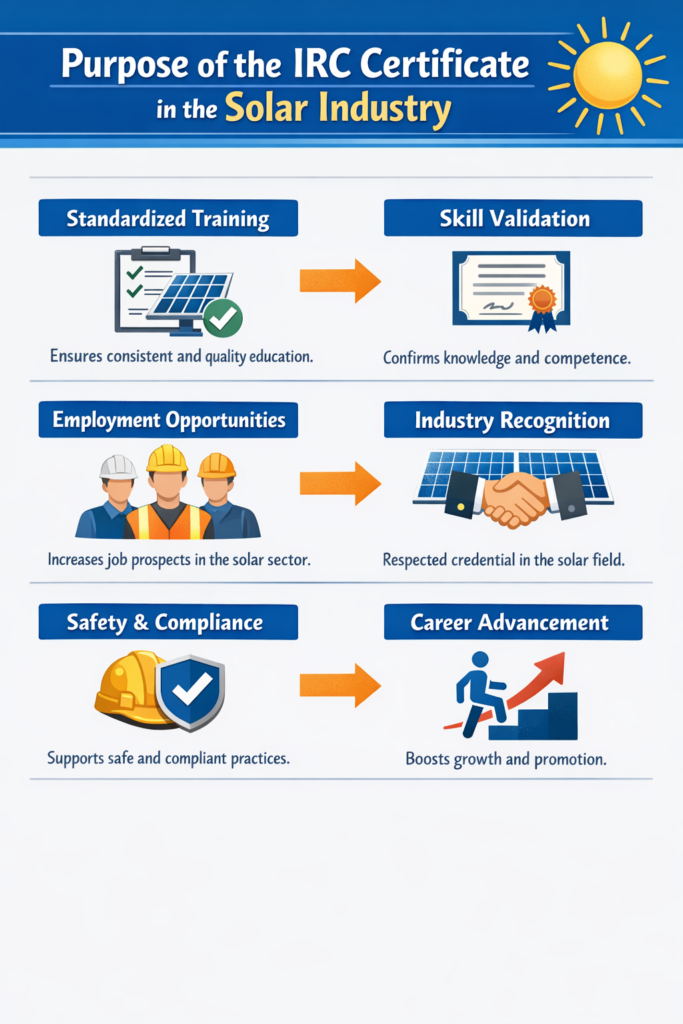
There are also many Purpose of the IRC Certificate in the Solar Industry and here we will discuss them one by one as follows.
Regulatory Compliance: It confirms that the solar system—including panels, inverters, and all related components—meets national or local regulations before being connected to the power grid.
Inspection Approval: The certificate verifies that the solar installation has been thoroughly inspected by an authorized body and is approved for operation.
Subsidy Eligibility: In many areas, receiving government incentives or rebates for solar systems requires proof of an IRC certificate.
Safety Assurance: It guarantees that the system follows proper safety standards, minimizing the risk of electrical faults or fire hazards.
Quality Control: The certification process ensures that certified equipment is used and that the installation is carried out by qualified professionals.
When Is an IRC Certificate Required?
There we will discuss completely step by step “When Is an IRC Certificate Required?
Project Type: Large-scale, industrial, or grid-connected residential projects generally need an IRC certificate.
Location: In countries such as India, Kenya, and some Middle Eastern regions, the IRC—or a local equivalent—is mandatory before the system can be commissioned.
Incentive Programs: Homeowners or businesses applying for subsidies, grants, or net-metering usually must include the IRC certificate as part of their documentation.
How to Get an IRC Certificate in 2026?
There we will also discuss completely How to Get an IRC Certificate step by step as follows.
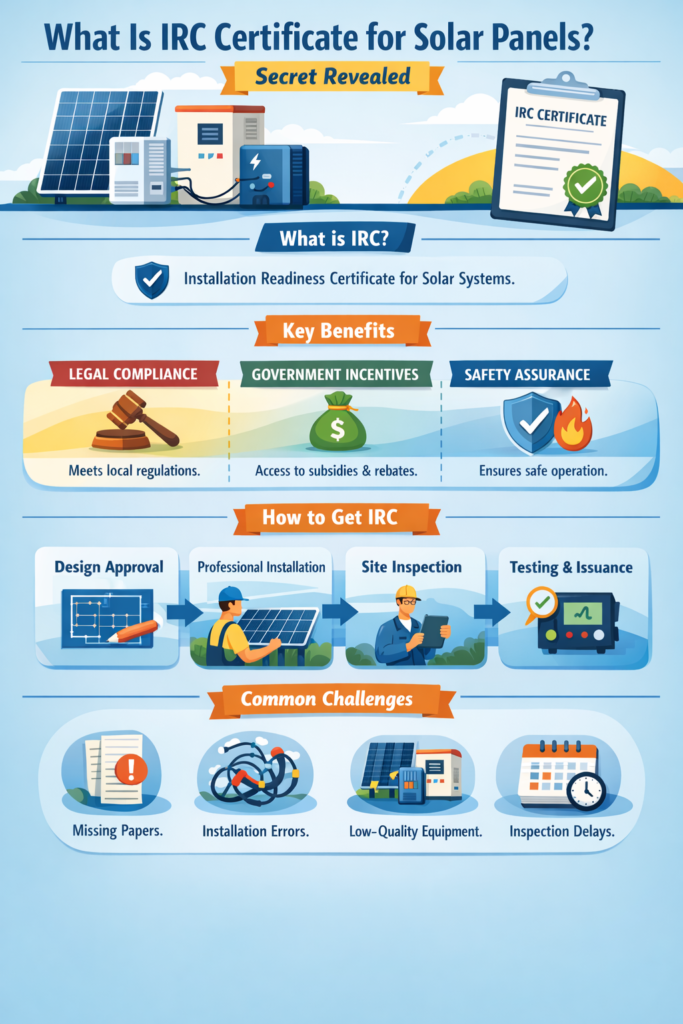
System Design and Approval
- A licensed solar engineer or contractor submits the solar system design to the relevant authority.
- The submission includes technical drawings, system details, safety measures, and certifications for components (like IEC or UL standards).
Installation
- Certified professionals install the solar system according to the approved plan.
- Proper grounding, cable management, spacing, and weatherproofing must be ensured.
Site Inspection
- A government inspector or authorized third-party visits the site.
- They check the installation quality, compliance with the approved design, and connection to the grid.
Testing
- The system is tested to ensure it works properly. Tests usually include:
- Inverter operation
- Power output and performance
- Load handling
- Emergency shut-off functions
Issuance of IRC Certificate
- If everything passes inspection and testing, the IRC certificate is issued.
- The certificate typically includes:
- Installer’s name and license number
- Installation site address
- System capacity (e.g., 5kW, 20kW)
- Date of inspection and approval
- Certificate validity period (if applicable)
Key Benefits of an IRC Certificate
There are also many Key Benefits of an IRC Certificate step by step in detail.
- Legal Compliance: The IRC certificate proves that your solar system meets all local or national laws, helping you avoid fines or disconnection from the grid.
- Access to Incentives: Many government subsidies, grants, or tax credits are only granted once the IRC certificate is provided, making it essential for funding approval.
- Enhanced Safety: Systems with an IRC certificate are checked against safety standards, reducing the risk of electrical accidents, failures, or fires.
- Higher Resale Value and Better Insurance: Homes or businesses with certified solar installations can have increased property value and may qualify for improved insurance terms since the system is officially verified.
Difference Between IRC and Other Certifications
| Feature | IRC (Installation Readiness Certificate) | Other Certifications (IEC, UL, etc.) |
|---|---|---|
| Purpose | Confirms system is ready for safe operation and grid connection | Certifies quality and safety of components (panels, inverters) |
| Focus | Entire installation, including design, installation, and safety | Individual products or equipment |
| Authority | Issued by local regulatory bodies or government inspectors | Issued by international or national standard organizations |
| Requirement for Incentives | Often mandatory for subsidies, grants, or net-metering | Usually not sufficient alone for incentive eligibility |
| Inspection | Includes site inspection and system testing | Product testing in labs |
| Validity | May have a validity period depending on local rules | Certification typically valid as long as product standard is maintained |
Common Challenges in Obtaining an IRC Certificate
There are also many Common Challenges in Obtaining an IRC Certificate and here we will discuss them.
- Incomplete Documentation: Missing or incorrect paperwork from installers can delay the certification process.
- Installation Mistakes: If the system’s wiring or layout does not match the approved design, the certificate may be rejected.
- Low-Quality Equipment: Using panels, inverters, or other components that are not certified can lead to denial of the IRC.
- Inspection Delays: Scheduling site inspections with government authorities can take longer, especially during busy installation periods.
Final Words
This is very informative news that IRC stands for Import Registration Certificate, a document that is required in many countries like USA, UK, and Australia to legally import goods, including solar panels and related equipment nowadays in 2026. However, in the solar industry, the term IRC certificate can have different meanings depending on local regulations. It may also refer to an International Renewable Certificate or an Installation Readiness Certificate, based on the specific context.
Amazing and accurate information always. Images can help me to understand whole process