
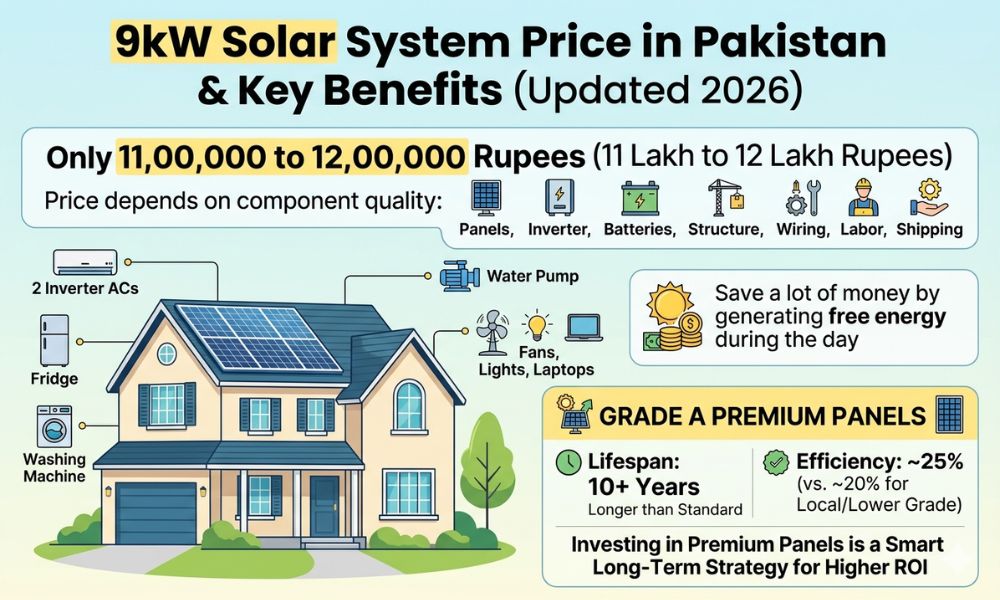
The latest and updated 9kW Solar System Price is only 11,00,000 to 12,00,000 rupees (11 lakh to 12 lakh rupees), which totally depends on the quality of solar panels, inverters, batteries, frames, wires, pipes, boards, labor, and shipping costs. In this price, all the necessary tools or components are included.
9kW Solar System is also the biggest and trending option that can only generate enough electricity or solar free energy to switch a big family house with 2 Inverter ACs as well as all appliances like fridges, washing machines, water pump, fans, lights, and laptops. By installing this big system at home, we will save a lot of money by generating free energy from the sun during the day.
Investing in premium solar panels is a smart long-term strategy. High-quality Grade A panels typically offer a lifespan at least 10 years longer than standard alternatives, ensuring a much higher return on investment.
While the upfront cost is slightly higher, the efficiency gains are significant. Grade A panels generally operate at around 25% efficiency, whereas local or lower-grade options often struggle to reach 20%.
What is a 9kW Solar System?
This is very informative news that A 9kW (kilowatt) solar system is a medium-to-large residential solar setup nowadays in the world in 2026. The “9kW” refers to the total peak power output capacity of the solar panels under ideal conditions, like sunny days with maximum sunlight.
- Solar Panels: It requires approximately 18 to 20 solar panels, assuming each panel has a rating between 540W and 585W.
- Roof Space: You will need a significant amount of shadow-free roof space, roughly 550 to 650 square feet.
- Energy Production: In Pakistan, which receives excellent sunlight, a well-installed 9kW system can generate between 1,100 and 1,350 units (kWh) of electricity per month. This can vary based on your location, panel orientation, and weather.
Detailed Breakdown of 9kW Solar System Price in Pakistan
There, we will completely discuss a Detailed Breakdown of the 9kW Solar System Price in Pakistan on grid and off-grid, and prices as well.
Estimated Price Range (On-Grid System)
A complete, installed 9kW On-Grid solar system in Pakistan generally costs between PKR 11,00,000 and PKR 12,00,000, which depends on quality, size, and brand in Pakistan.
Note: These prices are estimates and can fluctuate based on market conditions, US Dollar exchange rates, and specific brand choices.
Important Components & Cost Breakdown
| Component/Service | Description | Estimated Cost (PKR) |
| Solar Panels (Grade A) | The primary energy generators. (e.g., 20 x 450W panels) | 550,000 – 650,000 |
| Solar Inverter (On-Grid) | Converts DC power from panels to AC power for your home. | 250,000 – 300,000 |
| Mounting Structure | Aluminum or galvanized iron stands to hold the panels securely. | 80,000 – 120,000 |
| Balance of System (BOS) | DC/AC cables, DB boxes, breakers, surge protection (SPD), earthing. | 70,000 – 100,000 |
| Installation & Labor | Professional installation, wiring, and commissioning. | 50,000 – 80,000 |
| Net Metering Application | DISCO application fees, documentation, and bi-directional meter. | 30,000 – 50,000 |
| Transportation & Misc. | Moving equipment to the site and unforeseen minor expenses. | 20,000 – 30,000 |
| Total Estimated Cost | PKR 1000,000 – 12,150,000 |
Different Types of 9kW Solar Systems and Pricing
The type of solar system you choose dramatically affects the total cost. In Pakistan, three main types are common that we will discuss here.
1. On-Grid (Grid-Tied) Solar System
This is the most popular and affordable type for residential users who want to reduce their bills using net metering.
- How it Works: It is connected to the national grid (WAPDA/K-Electric). It powers your home during the day, and any excess energy is sent back to the grid. At night, you pull power from the grid.
- Components: Grade A panels, On-Grid Inverter, Net Meter. No batteries.
- Price: Lowest (Estimated PKR 8.5 Lakh to 11.5 Lakh).
- Best For: Users in areas with minimal load shedding who want maximum savings.
2. Hybrid Solar System
A hybrid system gives you the best of both worlds: grid connectivity and battery backup.
- How it Works: It works like an On-Grid system but includes a battery bank. It powers your home, charges the batteries, and sends excess to the grid. During a power outage, the batteries provide electricity.
- Components: Grade A panels, Hybrid Inverter, Battery Bank, Net Meter.
- Price: Higher (Estimated PKR 1,200,000 to PKR 1,600,000+), depending heavily on the type and capacity of batteries (Lithium-ion is much costlier than Lead-Acid).
- Best For: Areas with frequent or long power outages where backup power is essential.
3. Off-Grid Solar System
An Off-Grid system is completely independent of the national grid.
- How it Works: It relies entirely on solar panels and a very large battery bank to supply power 24/7.
- Components: Grade A panels, Off-Grid Inverter, Large Battery Bank. No Net Meter.
- Price: Highest (Estimated PKR 1,400,000 to PKR 2,000,000+), due to the massive battery storage required to cover night usage and cloudy days.
- Best For: Remote locations where the grid is unavailable or extremely unreliable. Not recommended for urban areas with reliable grid access due to high battery replacement costs.
Why You Must Install Grade A Solar Panels
When investing in solar, the quality of the panels is the single most critical factor for long-term performance and savings. Many users are tempted by cheaper, “local” or lower-grade panels, but this is often a costly mistake.
Here is why we strongly recommend always opting for Grade A Solar Panels:
- Significantly Longer Lifespan: Grade A panels are manufactured with higher quality control and better materials. They are designed to produce significant amounts of energy for at least 10 years longer than standard or lower-grade panels. While a Grade A panel has a warranted life of 25–30 years, a lower-quality panel’s performance may degrade rapidly after 10–15 years.
- Higher Efficiency: Grade A panels have a higher conversion efficiency. This means they can convert a larger percentage of sunlight into usable electricity.
- Grade A Panel Efficiency: Approximately 25% or higher.
- Normal/Local Panel Efficiency: Often 20% or less.
- Better Return on Investment: A 5% difference in efficiency might seem small, but over 25 years, it translates into thousands of additional units of electricity generated. The 10 extra years of high-performance operation from Grade A panels mean your system continues to save you massive amounts of money long after it has paid for itself.
| Feature | Grade A Panels | Standard/Local Panels |
| Efficiency | ~25%+ | 20% or less |
| Lifespan | 25–30+ years | 10–20 years (rapid degradation) |
| Cost | Slightly Higher | Lower Upfront |
| Energy Yield | Consistent, High | Lower, Drops Fast |
Investing in Grade A panels is not an extra expense; it is the key to maximizing the financial benefits of your solar system.
Key Factors Influencing the Cost of Solar in Pakistan
There are a lot of variables that can make the final price of your 9kW system higher or lower than the average estimate.
1. Solar Panel Brand and Type
Premium, Tier-1 brands (like Jinko Solar, Longi Solar, Canadian Solar, JA Solar, Trina Solar) that offer Grade A, monocrystalline PERC or N-Type panels will cost more than lesser-known brands or older polycrystalline technology.
2. Inverter Quality and Type
The inverter is the “brain” of the system. High-quality inverters (like Huawei, SMA, Fronius, Sungrow, Solis, Knox) are more expensive but offer better reliability, efficiency, and monitoring features. Hybrid inverters are also substantially more costly than simple on-grid inverters.
3. Mounting Structure Design
A simple ground-mount structure is cheaper. Elevated rooftop structures (needed to avoid shadows or use the roof space) require more materials (aluminum/steel) and engineering, which increases the cost.
4. Installation Complexity
A straightforward installation on a flat concrete roof is the baseline. Installations on pitched roofs, multiple roof levels, or requiring extensive cable runs will incur higher labor and material costs.
5. Net Metering Costs
Net metering is essential for an on-grid system. The cost includes application processing, DISCO fees, documentation, and purchasing the bi-directional meter. While some companies bundle this, others charge it separately.
Savings and Payback Period of a 9kW System in Pakistan
The real value of a 9kW solar system is the massive savings it provides over its lifespan.
Monthly and Annual Savings
Assuming your 9kW system generates an average of 1,200 units per month, and the average cost of electricity (including taxes and surcharges) is PKR 50 per unit:
- Monthly Savings: 1,200 units x PKR 50 = PKR 60,000 per month
- Annual Savings: PKR 60,000 x 12 = PKR 720,000 per year
Estimated Payback Period
The payback period is the time it takes for your energy savings to equal the initial investment cost. For a 9kW On-Grid system costing PKR 1,000,000:
- Total Cost: PKR 1,000,000
- Annual Savings: PKR 720,000
- Payback Period: PKR 1,000,000 / PKR 720,000 ≈ 1.4 Years
Due to the extremely high electricity tariffs in Pakistan, the payback period for On-Grid solar systems is exceptionally fast, often under 2 years for residential installations. After this point, your electricity is essentially free for the next 20+ years of the system’s life.
Note: The payback period for hybrid and off-grid systems is longer (3–5 years) because of the higher cost of batteries, which must also be replaced every 5–10 years.
What is Included in a Professional 9kW Solar Installation?
When you receive a quote for a 9kW solar system price in Pakistan, a “turnkey” solution should ideally include:
- Site Survey & Design: A technical team assesses your roof for shading, structure, and optimal layout.
- Equipment Procurement: Sourcing of Tier-1 Grade A panels, inverter, mounting structures, and all BOS components.
- Physical Installation: Mounting panels, installing the inverter, DB boxes, DC/AC wiring, and earthing/grounding systems.
- Net Metering Documentation: Handling the entire application process with your local DISCO (LESCO, K-Electric, IESCO, etc.).
- Testing & Commissioning: Ensuring the system is performing safely and efficiently before handover.
- After-Sales Support: Standard warranties on panels (25 years linear performance), inverter (5–10 years), and workmanship (1–2 years).
How to Get the Best Price and Quality for Your 9kW System
- Get Multiple Quotes: Contact at least 3–4 reputable solar EPC companies in your city. Compare their detailed component lists, warranties, and total prices.
- Demand Grade A Panels: Explicitly ask for Tier-1, Grade A panels and verify the serial numbers upon delivery. Do not compromise on panel quality.
- Check Inverter Warranties: Ensure the inverter has a minimum 5-year replacement warranty, preferably extendable.
- Verify Company Reputation: Look for companies with a proven track record, positive customer reviews, and valid PEC (Pakistan Engineering Council) registration.
- Focus on “Price Per Watt”: To compare quotes fairly, divide the total cost by the total wattage of the system (e.g., PKR 950,000 / 9000W = PKR 105.5 per watt).
- Understand Net Metering: Confirm that the company will handle the net metering process from start to finish.
Conclusion: Is a 9kW Solar System Worth It?
The latest and updated 9kW Solar System Price is only 11,00,000 to 12,00,000 rupees (11 lakh to 12 lakh rupees), which totally depends on the quality of solar panels, inverters, batteries, frames, wires, pipes, boards, labor, and shipping costs.
At this price, all the necessary tools or components are included. Yes, this 9kw solar system has a lot of worth because make free power for 25 years, which means that save millions of rupees in Pakistan.